As education systems worldwide shift from rote memorization to competency-based learning, Outcome-Based Education (OBE) has emerged as a powerful framework for driving measurable and meaningful student development. At the core of OBE lies the necessity to define clear, assessable learning outcomes — and this is where Bloom’s Taxonomy plays a pivotal role.
What is Bloom’s Taxonomy?
Developed by Benjamin Bloom and colleagues in 1956, Bloom’s Taxonomy is a hierarchical classification of the cognitive skills involved in learning. It provides educators with a structured model to define learning objectives that range from basic knowledge acquisition to higher-order thinking skills like analysis, evaluation, and creation.
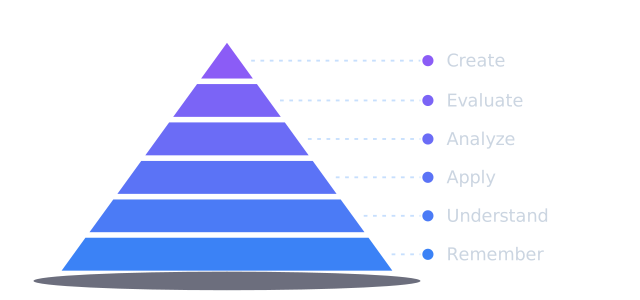
The revised version of Bloom’s Taxonomy, adapted by Anderson and Krathwohl, outlines six levels of cognition:
- Remember – Recall facts and basic concepts
- Understand – Explain ideas or concepts
- Apply – Use information in new situations
- Analyze – Draw connections among ideas
- Evaluate – Justify a decision or stand
- Create – Produce new or original work
Each level includes action verbs (e.g., define, describe, analyze, design) that help in writing learning outcomes and crafting assessments.
Integrating Bloom’s Taxonomy into OBE
- Designing Measurable Learning OutcomesIn OBE, the focus shifts from what teachers teach to what students are expected to achieve. Bloom’s Taxonomy offers a bank of cognitive levels and verbs that guide educators in writing clear, observable, and measurable learning outcomes.
- Aligning Curriculum and TeachingOBE requires strong alignment between intended outcomes, instructional strategies, and assessment methods. Bloom’s levels help educators select the appropriate teaching methods and activities based on the targeted cognitive level.
- Developing Course and Program OutcomesCourse Outcomes (COs) and Program Outcomes (POs) are fundamental components of OBE. Bloom’s framework ensures that these outcomes are mapped appropriately across different levels of difficulty and skill.
- Fostering Higher-Order Thinking Skills (HOTS)OBE aims to equip learners with 21st-century skills — critical thinking, problem-solving, creativity, and decision-making. Bloom’s higher-order categories guide the design of outcomes and assessments that encourage deep learning.
- Designing Effective AssessmentsAssessment in OBE must directly measure whether outcomes are achieved. Bloom’s Taxonomy helps in creating assessments that match the cognitive level of each outcome.
- Continuous Improvement and AccreditationAccrediting bodies emphasize well-defined learning outcomes and their attainment. Bloom’s framework makes it easier to track achievement, identify gaps, and inform curriculum revisions.